
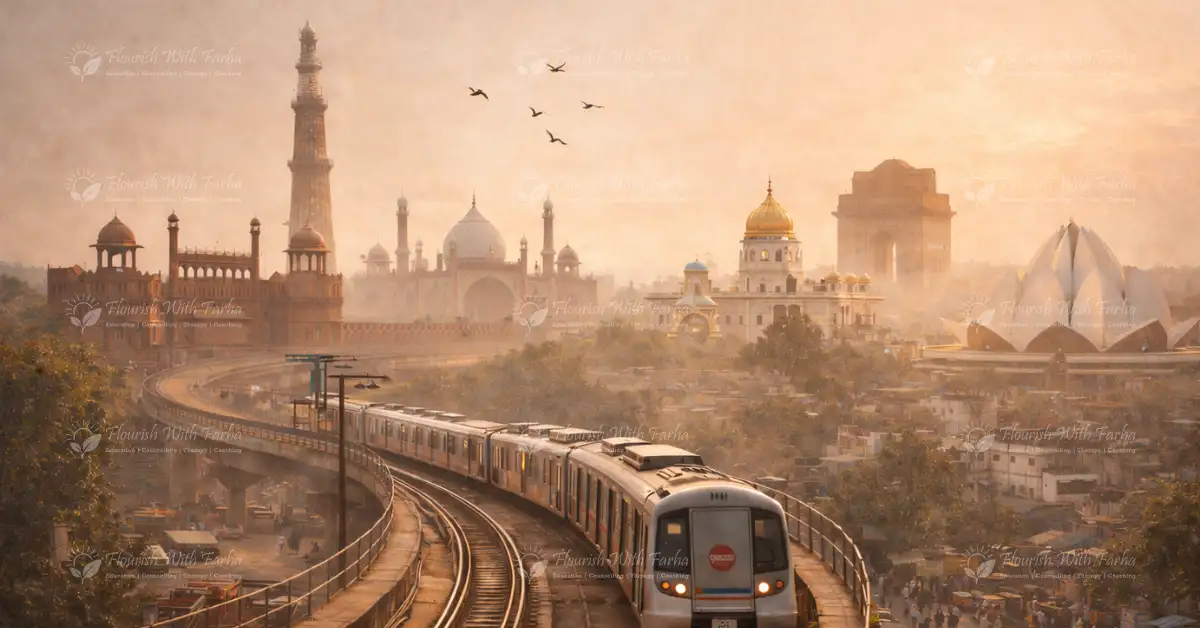
A City You Don’t Just Live In; A City You Carry
There are cities you visit.
There are cities you leave.
And then there are cities that quietly enter you, shape you, and stay even when they themselves change beyond recognition.
For me, that city is Delhi.
Not the Delhi you see in headlines.
Not the Delhi people debate, defend, or dismiss.
But the Delhi that raises you slowly, imperfectly, generously until one day you realize you don’t just live in it. You live with it.
When You’re Not “Originally From Here,” Yet You Are
Almost no one in Delhi is “originally” from Delhi.
And yet, those of us born and brought up here know something others don’t quite understand.
You may not know your ancestral village.
You may not speak the language your grandparents once did.
But grow up in Delhi long enough, and the city claims you.
You become a Delhiite not by paperwork, but by presence.
By the way you navigate crowds.
By how quickly you adapt.
By how naturally you belong without asking permission.
Delhi doesn’t ask where you came from.
It asks how you show up.
That idea, of being accepted for your presence rather than your history, connects to something Being Kind Does Not Mean Being Available explores. The idea that showing up matters, but only when it is chosen, not when it is expected.
The Delhi That Raised Me
The Delhi I grew up in wasn’t glamorous.
It was liveable.
It was:
- Streets where someone always knew a shortcut
- Local markets where affordability mattered more than aesthetics
- Shopkeepers who remembered faces, not just payments
- Auto rides negotiated with logic, humour, and instinct
- A city built on jugaad; not shortcuts, but solutions
Quick fixes, yes but not careless ones.
Smart adjustments. Practical thinking. Survival with dignity.
Delhi taught you how to manage life, not impress it.
Connectivity Beyond Roads And Metro Lines
People often talk about Delhi’s connectivity in terms of infrastructure.
But the real connection was human.
You could find help without asking too much.
Directions without Google.
Support without explanation.
There was a rhythm:
- Neighbours who intervened when something felt off
- Conversations at chai stalls that carried more wisdom than books
- Strangers who didn’t feel like strangers for long
That kind of ease, where connection happens without effort or performance, is rare. It is the opposite of what Some People Don’t Miss You Rather They Miss Access To You describes, where connection is replaced by transaction. Delhi, at least the Delhi I knew, was not like that.
It wasn’t perfect.
But it was alive.
Growth That Didn’t Erase the Soul Back Then
Delhi always grew.
But once upon a time, growth didn’t mean erasure.
New places opened, but old ones remained.
Change arrived, but memory wasn’t bulldozed overnight.
The city knew how to expand without forgetting itself.
That ability to hold both what was and what is becoming, without letting one destroy the other, is something Why You Outgrow People Who Once Felt Like Home speaks to as well. Growth does not have to mean erasure. But sometimes it does, and the grief that follows is its own kind of loss.
Today, that balance feels fragile.
When a City Becomes Infamous Instead of Familiar
It’s painful to watch a place you love become known for everything it never stood for.
Delhi is spoken about now in extremes:
- Too unsafe
- Too aggressive
- Too polluted
- Too fast
- Too much
But cities are not moral beings.
They are mirrors.
A place is never purely good or purely bad.
It only reflects what people experience within it.
This isn’t a defence of Delhi.
And it isn’t a shaming either.
It’s an acknowledgment that no single story gets to define a city.
The Delhi That Lives Inside Me
Even if the city changes and it has, what it gave me cannot be taken away.
Wherever I go, a part of Delhi goes with me:
- The adaptability
- The emotional intelligence needed to survive complexity
- The street-smart empathy
- The ability to hold contradictions without breaking
Delhi didn’t make me hard. It made me aware.
“Dilwalon Ki Delhi” Was Never About Geography
When people used to say “Yeh Dilwalon Ki Delhi Hai”, they weren’t talking about monuments or status.
They were talking about:
- Big emotions in small spaces
- Loud love, louder opinions
- Kindness hidden behind bluntness
- Hearts that felt deeply, even when lives were tough
Delhi’s heart was never about being the capital of India.
It was about being a capital of human complexity.
A City Only Some Will Ever Truly Know
The Delhi I know may not exist anymore at least not in the same way.
And that’s a quiet grief I carry.
Because the Delhi that raised me:
- Won’t appear on travel blogs
- Won’t trend on social media
- Won’t be understood by people passing through
It lives only in those who grew up here, who absorbed it before it became something else. That feeling of carrying something inside you that no one else can quite see or understand is quiet and lonely. When Silence Is Chosen, Not Avoided speaks to a similar kind of inner knowing, the kind that does not need words but simply exists.
This blog is not nostalgia for nostalgia’s sake. It’s documentation.
So that somewhere, someone reads this and thinks:
“Yes. This is the Delhi I knew too.”
Home Is Not Always a Place; Sometimes It’s a Memory You Carry
Delhi will always be my home.
Not because it is perfect.
But because it is mine.
It shaped how I think, feel, adapt, and survive.
It taught me to belong without ownership.
To love without denial.
To hold both pride and pain at once.
Cities change.
But what they give us when we grow up inside them stays.
And that is something no headline can erase.
And if that grief, the kind that comes from loving a place or a version of life that no longer exists, sits heavier than you expected, it is allowed to be felt. Counselling & Emotional Support is a space where that kind of quiet loss can be explored, gently, without needing to explain why it hurts so much.
Final Thoughts
If you’ve lived in a city long enough to feel it inside you, you’ll understand this.
And if Delhi has ever lived in you even quietly then you already know what I didn’t need to explain.
I have shared a few personal experiences from Punjab and Himachal as well, which you can read here if you feel like exploring further. They offer a different kind of holding than Delhi, gently and quietly, without asking anything in return.
Until next time, Farha
You Might Also Find These Reflections Helpful:
- Punjab, Without The Noise – On a place that feeds you, grounds you, and doesn’t pretend
- Himachal, As It Is – On a place that holds you quietly without asking anything in return
- Why You Outgrow People Who Once Felt Like Home – On grief, growth, and the loss that comes with change
- When Silence Is Chosen, Not Avoided – On the inner knowing that does not need words
- We Don’t Talk About Functional Burnout Enough – On the quiet exhaustion of carrying more than others can see
On Delhi, Memory, and the Cities That Shape Us
Why does Delhi have such a complicated reputation?
Delhi is one of the most densely populated and culturally layered cities in the world. Like any large city, it holds contradictions. It can be overwhelming and generous, chaotic and deeply human, all at the same time. The headlines tend to capture the extremes. But the lived experience of growing up here is far more nuanced than any single story can hold.
Is it normal to feel grief about a city changing?
Yes. When a place has shaped who you are, watching it transform can feel like a personal loss. The streets you grew up on, the rhythm of daily life you once knew, the version of the city that existed in your childhood, these are not just places. They are parts of your identity. Grieving their change is not nostalgia. It is a genuine emotional response to loss.
What makes someone a “Delhiite” if most people are not originally from there?
Delhi is a city built by migration. Almost no one’s family has been there for generations. What makes someone a Delhiite is not ancestry but absorption. It is growing up inside the city’s rhythm, learning its language of adaptation and survival, and carrying that way of being with you long after you leave. It is belonging through presence, not paperwork.
How does growing up in a city shape your personality?
Cities teach you things that classrooms cannot. A city like Delhi teaches adaptability, emotional intelligence, and the ability to navigate complexity without breaking. It teaches you to read people quickly, to find solutions under pressure, and to hold contradictions without needing to resolve them. These are not just survival skills. They are emotional and psychological strengths that stay with you.