
Farah, Farrah, Farrahh, Fara, Fareh, Farreh, Farrehh, Faha, Beg, Beig, Bag, Bage, Bake, Flourish With Farah… However You Spell It, This Is What I Actually Do
This is worth addressing first, as it tends to occur more often than expected.
People search for me as:
Farah .. Farrah .. Fareh .. Farah Baig .. Farha Beg .. Farah Beg .. Farha Bake .. Farah Bake .. Flourish With Farah
Even sometimes something completely different.
And honestly, I understand.
Because sometimes, it’s not just names that get misspelled.
It’s people, their needs, and their struggles that get misunderstood too.
So wherever you came from, however you searched, if support, clarity, learning, or direction is what you were and are still looking for, you’ve reached the right place.
I Am Not Meant To Fit Into One Definition; I Hold More Than One Role And That Is By Choice
I am Farha Baig. I am a:
- Special Education Specialist
- Special Educator
- Educator
- Therapist
- Counsellor
- Teacher
- Coach
- Learning Intervention Specialist
- Author
- Writer
- Blogger
- Content Creator
And no, these are not random labels. They exist because real problems are never just one-dimensional.
A child struggling academically may also be:
- dealing with attention issues
- facing emotional overwhelm
- lacking communication clarity
An adult struggling emotionally may also:
- feel stuck in expression
- lack structured thinking
- carry unprocessed experiences
So my work is not divided into boxes. It is intended to understand the person in their entirety; as a whole, not in parts.
The Range Of People I Work With, And Why It Is Not Limited To One Type Of Person
I work across:
Children
Teenagers
Adults
Couples
Parents
Individuals
Because learning, communication, behaviour, and emotional well-being do not belong to one age group.
The Areas I Work In, How They Connect To What You Are Seeking And Looking For
This is important to clarify for those seeking support online, as well as those looking for services in nearby areas.
If you have searched anything related to:
Learning Difficulties & Academic Support
- Dyslexia
- Dysgraphia
- Dyscalculia
- Slow learning
- Attention difficulties
- Learning delays
- Academic gaps
- Remedial education
- Special education classes
- Early childhood learning support
Neurodevelopmental & Behavioural Concerns
- ADHD (Attention Deficit Hyperactivity Disorder)
- Autism Spectrum
- Sensory issues
- Behavioural challenges
- Emotional regulation difficulties
- Feeding issues in children
Communication & Language Development
- Speech delay
- Language delay
- Pronunciation difficulties
- Lack of confidence in speaking
- Spoken English improvement
- Phonics-based learning
- Communication skills
Emotional & Psychological Support
- Anxiety
- Low confidence
- Emotional overwhelm
- Functional burnout
- Identity struggles
- Relationship boundaries
- Self-expression issues
Then yes, this is the nature of the work I do and offer.
What Makes My Approach Different
I do not believe in:
- one-size-fits-all teaching
- rushed therapy models
- generic advice
- surface-level fixes
What I focus on instead:
Understanding Before Intervention
Not just “what is wrong” but why it is happening
Personalised Learning & Therapy
Every session is adapted to how the individual functions
Blending Education + Therapy + Counselling
Because separating them often slows progress
Working With Reality, Not Ideal Conditions
Because life is not structured, so support should not be rigid either
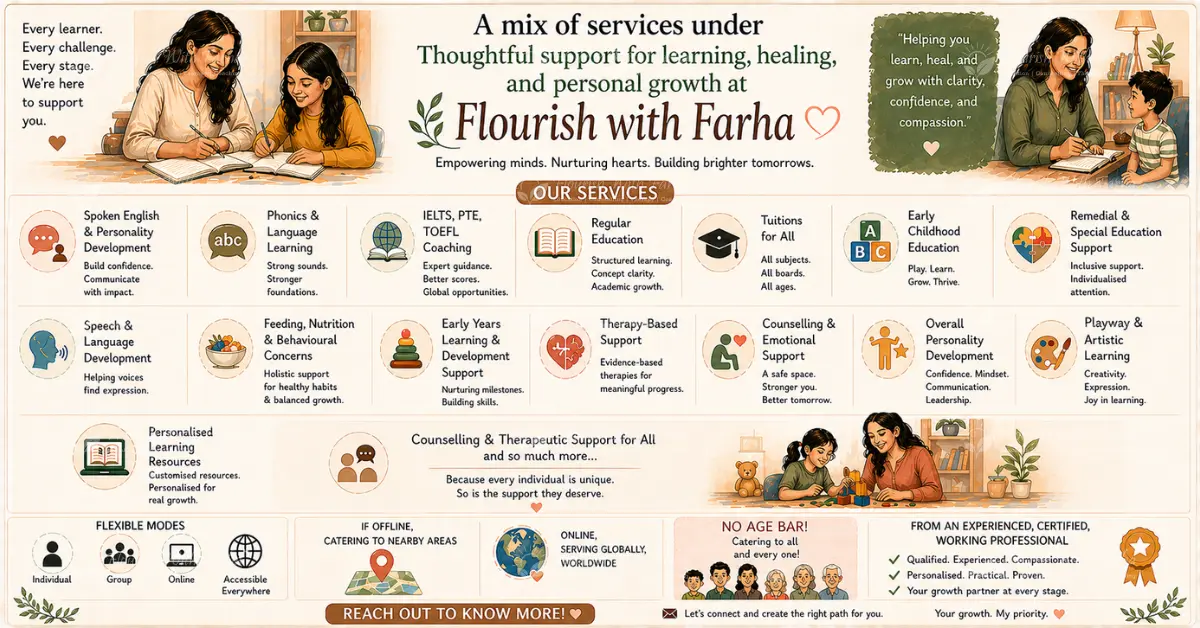
My Services (In Depth, So You Know Exactly What You’re Signing Up For)
This is not just a list. This is how things actually work.
Special Education & Remedial Support
For children facing:
- learning disabilities
- academic gaps
- school-related challenges
Includes:
- personalised learning plans
- remedial classes
- concept clarity
- pace-based teaching
Special education requires understanding that different minds engage differently with learning.
Early Childhood & Foundational Learning
For early learners needing:
- structured start
- attention building
- foundational skills
Includes:
- early years learning
- developmental support
- pre-academic readiness
Phonics & Communication Development
This is one of my core areas.
Includes:
- phonics-based reading and speaking
- spoken English
- pronunciation
- communication confidence
Because communication is not just language. It is safety, clarity, and expression.
Speech & Language Support
For:
- speech delay
- unclear communication
- expressive and receptive language issues
Counselling & Emotional Support
For children, teenagers, and adults dealing with:
- anxiety
- emotional overwhelm
- behavioural struggles
- identity and confidence issues
Therapy-Based Intervention
For deeper, structured work involving:
- emotional processing
- behavioural patterns
- functional burnout
- internal regulation
Coaching & Personality Development
For:
- communication improvement
- self-confidence
- structured thinking
- overall personality development
Feeding & Behavioural Concerns
Often ignored, but extremely important.
Includes:
- food-related behavioural challenges
- routine issues
- sensory-linked feeding patterns
Personalised Learning Materials
Not every struggle belongs to the child as the kid is not always the source of the difficulty.
Sometimes the material does not support their way of learning.
Artistic & Alternative Learning
For individuals who:
- respond better to creative expression
- need non-traditional learning methods
Regular Education Support
For those who:
- do not need special intervention but need structured academic guidance
How You Can Connect With Me
Everything is:
- Online and accessible
- One-on-one focused
- Transparent in structure and pricing
- Designed based on your actual requirement
No hidden processes. No unnecessary layers.
Where You Can Find Me (Even If You Spell It Differently)
If you’re searching for me, you might come across me on:
- My Website
- Instagram (@flourishhandthrivee)
- YouTube (@FlourishWithFarha)
- Facebook Page
- Facebook Profile
- Medium
- Tumblr
However you reach, it still leads to the same place.
Booking A Session
If you are:
- unsure where to begin
- confused about what kind of help you need
- noticing patterns but not understanding them
You don’t need to figure everything out first.
You can start here:
Book a consultation:
https://cal.com/flourish-thrive-g2m9wl/consult-now
Or directly book a session:
https://cal.com/flourish-thrive-g2m9wl/book-a-session
Not every struggle is loud. Not every difficulty is visible.
And not every solution is immediate. But understanding always comes first.
And once you understand better, you respond better.
Whether it is a child, or yourself. And that is where real work begins.
What Many People Try Before Seeking Help
Before someone reaches out to me, there is a significant part of the experience remains unspoken for a long time.
A phase where:
- they often handle things on their own, depending solely on themselves to cope
- they search online endlessly
- they compare their situation with others
- they wait for things to “settle”
Parents often:
- switch between tuition classes
- try different schools or teaching styles
- look for quick fixes
- hope the child “catches up”
Adults often:
- ignore their own emotional patterns
- continue functioning despite exhaustion
- try to self-regulate without understanding the root
And somewhere in between all of this, time passes.
Not dramatically. Not visibly.
But steadily.
Parents often handle everything alone before recognising that seeking clarity is care, not failure.
And this is where the real gap begins.
Why Advice Needs To Be Personal To Be Effective As General Advice Does Not Fit Everyone
Much of what you find online is not incorrect but it is not always applicable.
Because:
- children learn in different ways as each child learns in their own way
- adults process emotions differently as each adult processes emotions in their own way
- difficulties do not all come from the same place as each difficulty has its own origin
So when someone follows:
- general parenting advice
- random study techniques
- surface-level communication tips
And it does not work, they start questioning themselves.
But the issue is not always effort.
Sometimes, the issue is misalignment.
The Difference Between Support And Adjustment
A lot of people think they are supporting, when in reality, they are only adjusting temporarily.
There is a difference.
Adjustment looks like:
- managing behaviour in the moment
- helping complete tasks
- pushing through difficulties
Support looks like:
- understanding patterns
- identifying triggers
- building long-term skills
- creating internal stability
And this difference is subtle, but it changes everything over time.
When Learning Looks Like Resistance
Sometimes, what appears as:
- laziness
- distraction
- lack of interest
Is actually:
- cognitive overload
- processing difficulty
- lack of clarity
- emotional resistance
And when this is misunderstood, the response becomes pressure instead of support.
This is especially visible in:
- ADHD (Attention Deficit Hyperactivity Disorder)
- Dyslexia, Dysgraphia, Dyscalculia
- Autism Spectrum
- Speech and language delays
- Emotional and behavioural regulation difficulties
Where the child is not refusing, their struggle may not be immediately visible as what they are going through is not always easy to see.
When Adults Think It Is “Too Late”
A lot of adults reach out with one thought:
“Should I have done this earlier?”
And the answer is simple.
Earlier would have been different.
But now is still relevant.
Because patterns do not disappear with time.
They only become more internal.
This includes:
- communication difficulties
- confidence issues
- emotional suppression
- functional burnout
- difficulty expressing thoughts clearly
And working on these is not about age. It is about awareness and willingness.
What Progress Actually Looks Like Here
It is not always dramatic.
It is often:
- a child beginning to sit for a slightly longer time
- clearer speech over time
- slightly better understanding of concepts
- fewer emotional outbursts
- improved communication
And for adults:
- clearer thinking
- better expression
- reduced overwhelm
- improved boundaries
- more stable emotional responses
These changes may seem small, but they are not insignificant.
They are foundational.
Uncertainty Can Also Be Where You Begin
Many people often delay to reach out because they feel and are shaped by thoughts such as:
“I don’t have enough clarity yet.”
But clarity is not a prerequisite.
It is something that develops through:
- conversation
- observation
- structured understanding
So even uncertainty is valid.
This Work Is Not Limited To Labels
Yes, terms like:
- ADHD
- Autism
- Dyslexia
- Anxiety
- Speech delay
Help in understanding patterns.
But the work does not stop at labels.
Because two individuals with the same label can function very differently.
So the focus always remains on:
- how the individual responds
- how they process
- what they need specifically
You Do Not Have To Wait For Things To Get Ugly To Seek Help Or Before It Feels Urgent
This is something I say often, because it matters.
You do not have to wait for:
- failure
- breakdown
- extreme behaviour
- complete overwhelm
To take something seriously.
You can choose to understand earlier.
When something has been on your mind repeatedly, it usually means it needs attention so you don’t have to wait for it to become worse.
And when you do that, you prevent a lot of unnecessary struggle.
Final Thoughts
And if you have reached till here, then something has already held your attention.
Maybe something resonated. Maybe something felt familiar. Maybe something made sense.
And that is usually where things begin.
Not with a big decision but with a small recognition.
Until next time, Farha
Key Services Quick Reference
Educational Support: Special Education | Remedial Support | Early Childhood Learning | Phonics | Regular Education | Artistic Learning
Therapeutic Support: Counselling & Emotional Support | Therapy-Based Intervention | Speech & Language Support | Feeding & Behavioral Concerns
Development Support: Personality Development | Communication Skills | Coaching
Who: Children | Teenagers | Adults | Parents
How: Online (Worldwide) | Offline (Nearby Areas) | Individual | Group Sessions
Book Now:
- Consultation: https://cal.com/flourish-thrive-g2m9wl/consult-now
- Session: https://cal.com/flourish-thrive-g2m9wl/book-a-session
FAQ:
Who is Farha Baig and what does she do?
I am Farha Baig (also searched as Farah, Farrah, Fareh, Farah Baig, Farha Beg, and various other spellings). I am a Special Education Specialist, Educator, Therapist, Counsellor, Teacher, Coach, Learning Intervention Specialist, Author, Writer, Blogger, and Content Creator. These are not random labels; they exist because real problems are never one-dimensional. A child struggling academically may also be dealing with attention issues, emotional overwhelm, or communication clarity challenges. An adult struggling emotionally may feel stuck in expression, lack structured thinking, or carry unprocessed experiences. My work is not divided into boxes; it understands the person in their entirety; as a whole, not in parts.
What areas and conditions does Farha Baig work with?
I work across Learning Difficulties (dyslexia, dysgraphia, dyscalculia, slow learning, attention difficulties, academic gaps, remedial education, special education); Neurodevelopmental & Behavioural Concerns (ADHD, Autism Spectrum, sensory issues, behavioural challenges, emotional regulation, feeding issues); Communication & Language Development (speech delay, language delay, pronunciation difficulties, spoken English, phonics-based learning, communication skills); and Emotional & Psychological Support (anxiety, low confidence, emotional overwhelm, functional burnout, identity struggles, relationship boundaries, self-expression issues). I work with children, teenagers, adults, individuals, couples and parents because learning, communication, behaviour and emotional well-being do not belong to one age group.
What makes Farha Baig’s approach different?
I do not believe in one-size-fits-all teaching, rushed therapy models, generic advice, or surface-level fixes. Instead, I focus on: Understanding Before Intervention (not just “what is wrong” but why it is happening), Personalised Learning & Therapy (every session adapted to how the individual functions), Blending Education + Therapy + Counselling (because separating them often slows progress), and Working With Reality, Not Ideal Conditions (because life is not structured, so support should not be rigid either). The work does not stop at labels as two individuals with the same diagnosis can function very differently, so the focus always remains on how the individual responds, processes, and what they need specifically.
When should someone seek support from Farha Baig?
You do not have to wait for failure, breakdown, extreme behavior, or complete overwhelm to take something seriously. You can choose to understand earlier. Many people delay reaching out because they think “I don’t have enough clarity yet,” but clarity is not a prerequisite as it develops through conversation, observation, and structured understanding. Even uncertainty is valid. If something has been on your mind repeatedly, it usually means it needs attention. The difference between support and adjustment matters: adjustment manages behavior in the moment, while support understands patterns, identifies triggers, builds long-term skills, and creates internal stability.