A Place That Feeds You, Grounds You, and Doesn’t Pretend
Punjab doesn’t introduce itself slowly.
It doesn’t warm up to you with politeness or distance.
It arrives whole.
In its food.
In its weather.
In its people.
In its rhythm.
And once you’ve lived here not visited, not passed through, but stayed; you realise Punjab isn’t trying to impress anyone. It’s simply being what it has always been.
A Land That Knows How to Hold People
Punjab feels inhabited, not occupied.
There’s a difference.
Cities and towns across the state whether it’s Patiala, Mohali, Ludhiana, Jalandhar, Zirakpur, or Amritsar don’t feel built to compete. They feel built to live.
Life happens openly here.
Nothing feels overly curated.
Nothing feels excessively guarded.
There’s space: emotional and physical to exist as you are.
This feeling of being held without being asked to perform is rare. It is something When Silence Is Chosen, Not Avoided touches on from a different angle, the quiet relief of being in a space, whether a place or a relationship, where you are not expected to explain yourself.
Food That Doesn’t Ask If You’re Hungry As It Assumes You Are
Punjab feeds you before it questions you.
Food here is not a lifestyle choice.
It’s a value system.
Meals are generous, unapologetic, grounding.
They don’t whisper. They nourish.
There’s something deeply humbling about food that is:
- Meant to sustain, not restrict
- Shared without calculation
- Offered without judgement
Eating in Punjab reminds you that care doesn’t need to be subtle to be sincere.
Seasons That Keep You Honest
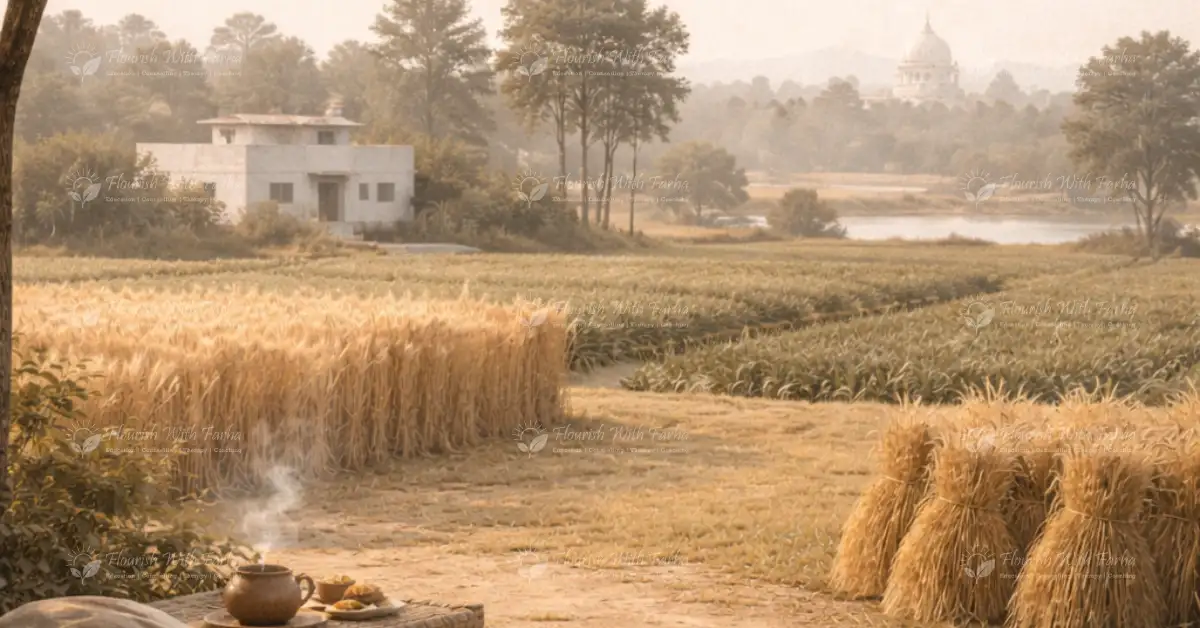
Living through a full year in Punjab means experiencing everything.
The sharp cold.
The unapologetic heat.
The in-between months that test patience.
Punjab doesn’t protect you from climate, it introduces you to it.
You learn to adapt.
You learn to slow down when the heat demands it.
You learn endurance in winter.
You learn gratitude in harvest seasons.
The land teaches rhythm not control.
Between Haryana and Himachal Yet Entirely Its Own
Punjab sits geographically between Haryana and Himachal Pradesh, but emotionally, it stands on its own ground.
From Haryana, it carries a sense of:
- Practical living
- Agricultural rhythm
- Everyday resilience
From Himachal, it echoes:
- Groundedness
- Respect for land and seasons
- A quieter inner pace
Himachal carries that groundedness even more visibly. Himachal, As It Is is a reflection on what it feels like to be in a landscape that doesn’t ask anything of you, only presence.
Yet Punjab adds something neither holds in the same way i.e. warmth without reserve.
Not formality.
Not distance.
Warmth.
A way of making space for people loudly, openly, without hesitation.
Affordability That Feels Like Relief
One of the most understated realities of Punjab is how livable it is.
Life here doesn’t constantly negotiate with your wallet.
Daily needs feel manageable.
Food and living don’t demand constant compromise.
There’s a quiet relief in that.
Punjab lets you breathe financially and emotionally.
People Who Don’t Perform Kindness
People here don’t package warmth as politeness.
They are direct.
Sometimes loud.
Often expressive.
But sincerity runs deep.
Whether it’s in smaller towns like Dera Bassi or quieter villages like Dhakoli, there’s a sense that people show up without overthinking it.
Care is practical here.
Help is straightforward.
Hospitality isn’t performative.
There is something freeing about people who don’t dress up their care. It connects to a broader pattern that Being Kind Does Not Mean Being Available explores, the idea that genuine kindness is not about performance or constant availability, but about showing up honestly when it matters.
Chandigarh: Order in the Middle of Abundance
And then there is Chandigarh: calm, planned, almost meditative compared to the rest.
Chandigarh feels like Punjab decided to pause and organise its thoughts.
Wide roads.
Green spaces.
A sense of order.
It doesn’t replace Punjab’s rawness rather it complements it.
A reminder that structure and softness can coexist.
What Living in Punjab Teaches You
Stay long enough, and Punjab quietly shifts you.
It teaches you:
- That abundance doesn’t have to be excessive
- That generosity can be routine
- That life doesn’t need constant urgency
- That nourishment is not indulgence
This kind of quiet fullness, the kind that comes from simply living well without urgency, is something that many of us have forgotten how to access. We Don’t Talk About Functional Burnout Enough speaks to what happens when we lose touch with that ease entirely, and how recognizing it matters.
It humbles you not through struggle, but through fullness.
A Place That Doesn’t Ask You to Be Less
Punjab doesn’t ask you to shrink.
It doesn’t demand refinement.
It doesn’t expect restraint.
It allows presence. And presence, when it is allowed rather than demanded, becomes a form of healing in itself. When The Healer Needs Healing reflects on what it means to find that kind of space when you are someone who has spent years giving it to others.
And that, in itself, is grounding.
Final Thoughts
Punjab is not a place you analyse too much.
It’s a place you experience.
It feeds you.
It steadies you.
It makes room for all seasons inside and out.
And when you leave, what stays isn’t just memory.
It’s a sense that life can be lived fully without apology.
If you recognise that feeling, of needing a space where you are allowed to simply be, and you have not found that yet in your own life, you are welcome to get consulted, where you feel like there is a space built around exactly that, no pressure, no expectation, just room.
This is not an evaluation of Punjab. It’s a lived reflection. If you’ve stayed here long enough, you’ll recognise what wasn’t spelled out.
Until next time, Farha
You Might Also Find These Reflections Helpful:
- Himachal, As It Is – On a place that holds you without asking anything in return
- Delhi, Before It Became A Headline – On seeing a city the way it actually lives, not how it is reported
- When Silence Is Chosen, Not Avoided – On the relief of not having to explain yourself
- Being Kind Does Not Mean Being Available – On presence that comes from choice, not obligation
- We Don’t Talk About Functional Burnout Enough – On what happens when we lose touch with ease
On Punjab, Living Well, and Quiet Observations
What makes Punjab different from other states to live in?
Punjab is not just a geography. It is a way of being. The food is generous without being showy. The people are direct without being unkind. The cost of living is manageable without feeling like a compromise. What makes it different is that it does not ask you to perform. It simply makes space for you.
Is Punjab only known for its loud, vibrant culture?
That is the version most people encounter first. But living here, rather than visiting, reveals something quieter. There is depth beneath the energy. There is stillness in the villages, calm in the smaller towns, and a deep sense of belonging that does not require you to be loud yourself.
Why do people feel so grounded after living in Punjab?
Punjab teaches a kind of humility that comes not from hardship but from fullness. When life around you is generous, unhurried, and unapologetic, it becomes difficult to hold onto the belief that you need to constantly strive or shrink. The land and the people together create something that quietly shifts your relationship with yourself.
How does Punjab compare to Himachal Pradesh or Delhi as a place to live?
Each holds a different kind of peace. Himachal offers stillness through landscape. Delhi offers energy through movement. Punjab offers warmth through people. They are not competing. They are simply different ways of being grounded, and each one teaches something the others cannot.